
The unseen symphony of space weather
Beneath the expansive Oklahoma sky, where the Arkansas River carves its path through Tulsa, an invisible cosmic drama unfolds with surprising regularity. While the visual spectacle of the aurora borealis is a rare and faint whisper in these latitudes, the underlying forces of geomagnetic storms exert a silent, pervasive influence on the city's modern tapestry. These events, born from the Sun's tempestuous activities, send waves of charged particles hurtling towards Earth, capable of unsettling our technologically dependent world.
Tulsa, a vibrant urban center, remains largely oblivious to these solar bombardments, yet its infrastructure, from power grids to communication networks, subtly contends with their distant impact. It is a testament to the planet's magnetic shield that life continues undisturbed, but the increasing reliance on complex electronics means a heightened vulnerability to phenomena once considered purely academic. The interplay between the Sun's raw power and Earth's protective embrace creates a delicate balance, one that occasionally teeters during periods of intense solar activity.
Invisible currents, tangible ripples
When a coronal mass ejection (CME) or a high-speed solar wind stream reaches Earth, it compresses and rattles our planet's magnetosphere. This disturbance induces geomagnetically induced currents (GICs) in long conductors like power lines and pipelines. For Tulsa, nestled deep within the North American continent, these currents can still be significant, stressing transformers and potentially causing outages. They are a phantom menace, unseen yet capable of disrupting the very arteries of our electrified existence.
"The cosmos hums with an energy we rarely perceive, yet it sculpts the very fabric of our technological reality."
Beyond the power grid, the subtle dance of magnetic fields can interfere with satellite signals vital for GPS, disrupting navigation, precision agriculture, and even banking transactions. High-frequency radio communications, critical for aviation and emergency services, can experience blackouts. Even pipeline corrosion can accelerate under certain geomagnetic conditions, a testament to the far-reaching and often unexpected consequences of these solar tempests.
Tulsa's quiet vigilance
Despite its distance from the polar regions, Tulsa's strategic location within the continental United States means its critical infrastructure is part of a larger interconnected system. A major geomagnetic storm impacts a vast area, and local vulnerabilities can cascade into regional or even national issues. Engineers and system operators in and around Tulsa maintain a quiet vigilance, monitoring space weather forecasts and preparing for potential disturbances that could challenge the reliability of local services.
Infrastructure at risk
The intricate web of power lines that energize Tulsa, stretching across the plains, acts as an unwitting antenna for geomagnetically induced currents. Transformers, especially those at higher voltages, are particularly susceptible to saturation, leading to overheating and potential failure. Such events, while rare at severe levels for Tulsa, represent a continuous, albeit low-probability, threat that demands foresight and robust system design.
"In the quiet hum of our modern cities, lies a subtle vulnerability to the Sun's most powerful exhalations."
Communication networks, including cellular towers and fiber optic lines, are also indirectly affected. While fiber optics themselves are immune to GICs, the electronics that power them, as well as the satellites they rely on, are not. The robust operation of Tulsa's digital heartbeat depends on the harmonious function of a global constellation of technological marvels, all susceptible to solar whims.
The elusive glow
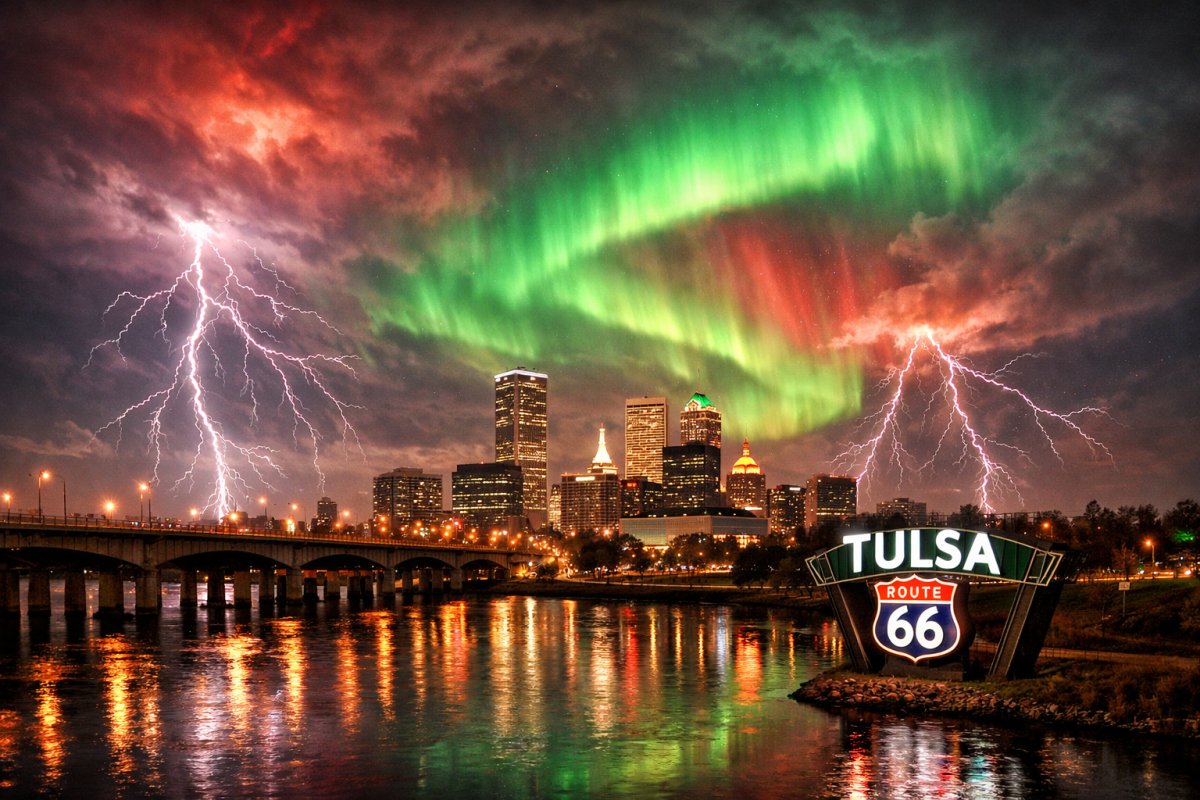
While extremely rare, a truly colossal geomagnetic storm could, in theory, push the aurora borealis far enough south to be faintly visible from Tulsa's light-polluted skies. Such an event would require a Kp-index of 8 or 9, a phenomenon observed only a handful of times in recorded history. For most Tulsans, the concept of the northern lights dancing over their city remains a beautiful, almost mythical notion, a celestial dream rarely fulfilled but always a possibility during the most extreme solar outbursts.
Decoding the solar whispers
Understanding and predicting magnetic storms is a critical endeavor, driven by global observation networks and sophisticated modeling. Scientists continuously monitor the Sun's surface for flares and CMEs, analyzing their trajectory and intensity to provide advance warnings. These predictions are crucial for operators of power grids, satellites, and other sensitive systems, allowing them to take precautionary measures.
Key metrics of geomagnetic activity
To quantify the intensity and potential impact of magnetic storms, several parameters are used. These metrics help scientists and engineers assess the severity of space weather events and their likely effects on Earth-based systems, offering a common language to describe the Sun's influence.
| Parameter | Description | Typical Impact Threshold |
|---|---|---|
| Kp-index | Planetary K-index, a global measure of geomagnetic activity level (0-9) | Kp 5+ (minor storm begins) |
| Bz (nT) | North-south component of the Interplanetary Magnetic Field (IMF) | Sustained negative Bz (indicates storm onset) |
| Solar Wind Speed (km/s) | Velocity of solar particles reaching Earth's magnetosphere | High speeds (> 500 km/s) amplify storm effects |
| Proton Flux (pfu) | Number of energetic protons per square centimeter per second per steradian | > 10 pfu (radiation storm, satellite risk) |
| Dst-index (nT) | Disturbance Storm Time index, measures worldwide magnetic disturbance | Negative values (< -50 nT) indicate storm intensity |
These parameters are constantly monitored by agencies like NOAA's Space Weather Prediction Center, providing real-time data and forecasts that are invaluable for protecting critical infrastructure worldwide, including components that serve Tulsa.
Mitigating the cosmic surge
Preparedness for magnetic storms involves a multi-faceted approach, combining robust engineering, continuous monitoring, and strategic planning. While we cannot prevent solar eruptions, we can significantly reduce their disruptive potential through smart design and proactive management. For a city like Tulsa, whose economic vitality relies on seamless connectivity and reliable power, these mitigation strategies are more than just technicalities; they are safeguards for its very pulse.
Technological resilience
Power grid operators continually invest in hardening their systems against GICs. This includes installing specialized devices that block or redirect these currents, improving transformer designs to withstand stress, and implementing operational procedures that allow for swift adjustments during geomagnetic events. These measures are designed to ensure that even during powerful solar storms, the lights stay on and the crucial flow of energy remains uninterrupted.
"The silent strength of our technology lies in its ability to withstand the universe's most dramatic whispers."
For satellite communication and GPS systems, resilience involves using redundant satellites, developing interference-resistant receivers, and continually updating algorithms to compensate for signal disruptions. Aviation and maritime industries, heavily reliant on these technologies, also have protocols in place to revert to alternative navigation methods if necessary. The goal is to build layers of defense, creating a robust shield against the unpredictable temper of our star.
A dialogue with the cosmos
The phenomenon of magnetic storms in Tulsa serves as a compelling reminder of our planet's intimate connection to the broader cosmos. It highlights that even in our most technologically advanced urban environments, we are still participants in a grander celestial ballet. The subtle tremors in the Earth's magnetic field, though often imperceptible to human senses, underscore the need for a deeper understanding and respect for the natural forces that shape our existence.
This ongoing dialogue between Sun and Earth, manifest in the ebb and flow of geomagnetic activity, drives innovation in space weather research and engineering. It compels us to design more resilient systems, to predict with greater accuracy, and to continually adapt to the dynamic environment of our solar system. Tulsa, like any modern city, is an active participant in this cosmic conversation, its silent struggle against solar eruptions a testament to humanity's enduring quest for stability amidst universal flux.