
A celestial ballet over the Sonoran Desert
The sun's fiery breath
From its incandescent core, the sun routinely ejects vast quantities of plasma and magnetic fields into the cosmos, a phenomenon known as space weather. These solar emissions, ranging from explosive solar flares to colossal coronal mass ejections (CMEs), hurtle through the void, eventually encountering Earth's protective magnetic sheath. While often conceived as distant cosmic events, their reverberations are intimately felt even in the tranquil, sun-baked expanses around Tucson.
The desert air, usually a conduit for light and heat, can also become a canvas for these invisible forces. When a powerful CME strikes our planet's magnetosphere, it can trigger what we call a geomagnetic or magnetic storm. This interaction causes the Earth's magnetic field to oscillate and reconfigure, creating currents that ripple through the very ground beneath our feet and the ionosphere above.
Tucson's magnetic canvas
Tucson, nestled within the sprawling Sonoran Desert, offers a distinctive vantage point for contemplating these solar-terrestrial connections. Its clear night skies, despite growing light pollution, occasionally betray the faint, elusive whispers of auroral activity during particularly intense geomagnetic disturbances. More commonly, the invisible effects manifest through less dramatic, yet equally profound, alterations to the local electromagnetic environment.
The desert landscape itself, with its unique geological composition and low-humidity atmosphere, can subtly influence how these induced currents propagate. Unlike higher latitudes where aurora borealis dazzles with regularity, Tucson experiences a subtler interplay, a more ethereal manifestation of the sun's distant rage. Understanding these dynamics is crucial for both scientific inquiry and the safeguarding of modern infrastructure.
Unseen currents and subtle shifts
Geomagnetic induction and infrastructure
Magnetic storms aren't just a spectacle for sky-watchers; they pose tangible challenges to technological systems. When Earth's magnetic field experiences rapid fluctuations, it can induce geomagnetically induced currents (GICs) in long conductors like power transmission lines, pipelines, and telecommunication cables. While Tucson's latitude generally places it outside the most severe impact zones for GICs, particularly strong storms can still create measurable disturbances.
These induced currents can stress transformers, disrupt relay operations, and potentially lead to localized power grid instabilities. For operators in the Southwest, monitoring space weather alerts from organizations like NOAA's Space Weather Prediction Center (SWPC) is a critical part of maintaining grid reliability. Beyond power systems, even subtle changes in the magnetic field can affect GPS accuracy and high-frequency radio communications, impacting aviation and emergency services.
Wildlife and human perception
The animal kingdom, particularly migratory species, has long been known to utilize Earth's magnetic field for navigation. Birds, sea turtles, and even bats possess a remarkable magnetoreception ability. In Tucson, resident and migratory bird populations, navigating the vast desert and mountain ranges, might experience subtle disorientations during significant magnetic storms.
For humans, the effects are less scientifically quantified but frequently reported anecdotally. Some individuals claim to experience headaches, sleep disturbances, or shifts in mood during periods of heightened geomagnetic activity. Others report peculiar electrical phenomena, like flickering lights or unexplained static, though these are often difficult to definitively link to solar events without rigorous data. The desert's inherent quietude can sometimes amplify these subtle perceptions, leading to a heightened awareness of unseen forces.
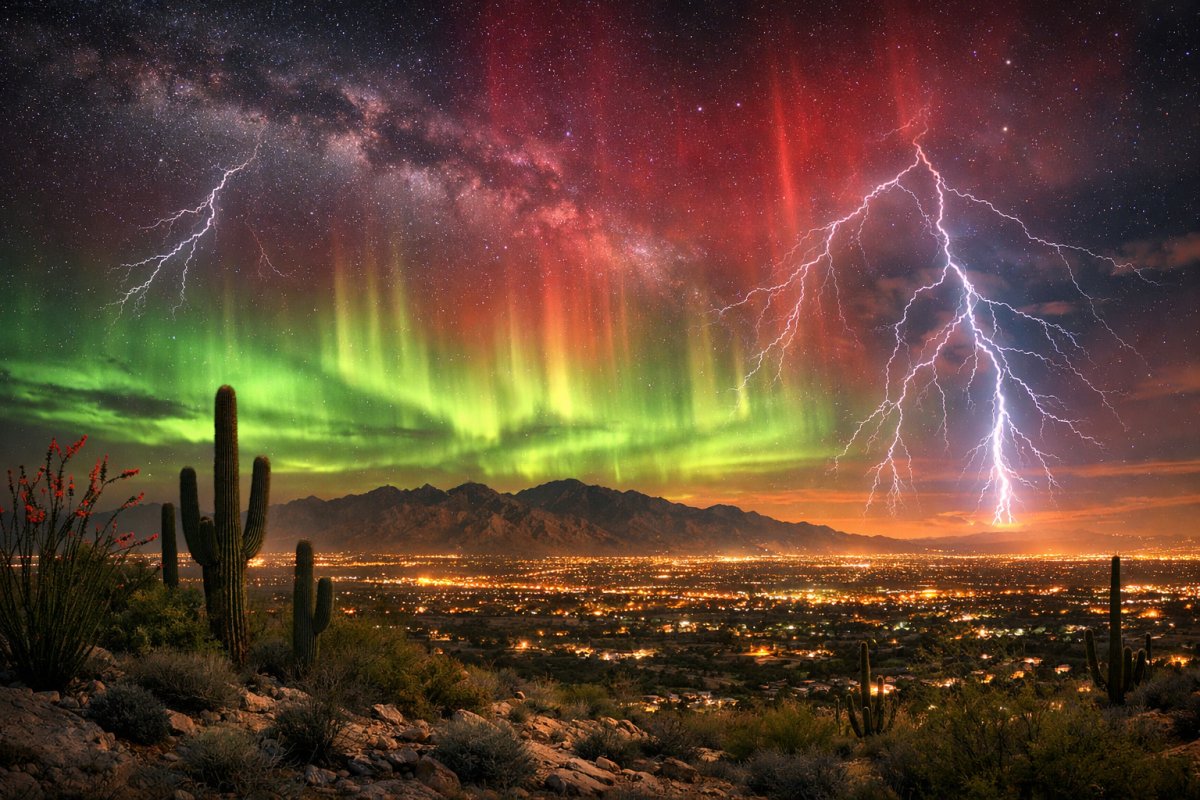
The desert whispers its secrets not just through wind and sand, but also through the silent tremors of its magnetic heart.
These experiences, while subjective, add a fascinating layer to the scientific understanding of geomagnetic events, inviting further exploration into the intricate relationship between cosmic phenomena and terrestrial life.
Observing the unseen aurora's faint glow
Challenges of low-latitude aurora
For most of the world, the aurora borealis and australis are vibrant, dancing curtains of light. In Tucson, however, the experience is far more subdued, a testament to its southern latitude. Auroral displays occur when energized particles from the solar wind collide with atmospheric gases, typically concentrated around the magnetic poles. For these lights to be visible near the equator, an exceptionally powerful geomagnetic storm is required, pushing the auroral oval significantly equatorward.
Even under such rare conditions, the aurora seen from Tucson would likely appear as a faint, reddish glow very low on the northern horizon, easily obscured by light pollution from the city. The desert's typically dry air and clear skies do offer some advantage, but the sheer distance from the magnetic poles remains the primary hurdle for spectacular sightings. Patience, dark sky locations far from urban sprawl, and a high Kp-index forecast are the requisites for any hopeful aurora chaser in Arizona.
Amateur astronomers and space weather enthusiasts
Despite the challenges, Tucson is home to a vibrant community of amateur astronomers and space weather enthusiasts. Equipped with specialized cameras, sensitive magnetometers, and a keen understanding of solar forecasts, these individuals form a crucial network for monitoring geomagnetic activity. Organizations like the Tucson Amateur Astronomy Association often share real-time updates and advise on optimal viewing conditions during anticipated events.
Their contributions extend beyond mere observation; they serve as a ground-level sensor network, providing valuable data points that complement professional observatories and satellite measurements. This synergy between citizen science and established research institutions enhances our collective understanding of how magnetic storms impact diverse geographical regions, including the unique electromagnetic signature of the Sonoran Desert.
Measuring the invisible flux
Key geomagnetic parameters
To quantify the intensity and potential impact of magnetic storms, space weather scientists rely on several key parameters. These indices provide a snapshot of the solar wind's characteristics and its interaction with Earth's magnetosphere. Understanding these values is fundamental for predicting geomagnetic activity and assessing its reach to locations like Tucson.
| Parameter | Description |
|---|---|
| Kp-index | A global index ranging from 0 to 9, indicating the maximum deviation of the horizontal component of the geomagnetic field from a quiet day over a 3-hour period. Higher values (Kp5 and above) signify geomagnetic storm conditions. |
| Bt (Total IMF) | The total strength of the interplanetary magnetic field (IMF) in nanoteslas (nT). Larger Bt values can indicate stronger potential for interaction with Earth's magnetosphere. |
| Bz (IMF North-South Component) | The north-south component of the IMF. A strong, sustained southward (negative) Bz is crucial for coupling with Earth's northward magnetic field, allowing solar wind energy to enter the magnetosphere and fuel geomagnetic storms. |
| Solar Wind Speed | The velocity of the solar wind, measured in kilometers per second (km/s). Faster solar wind speeds typically lead to more intense geomagnetic activity upon impact. |
| Proton Density | The number of protons per cubic centimeter in the solar wind. Higher proton density can enhance the dynamic pressure on the magnetosphere, contributing to storm intensity. |
Monitoring these parameters allows researchers and infrastructure operators in Tucson to anticipate potential disruptions and prepare accordingly. For instance, a prolonged negative Bz coupled with high solar wind speed and a rising Kp-index would trigger alerts for possible impacts on local systems.
Preparing for the solar surge
Mitigation and awareness
While the full impact of severe magnetic storms might be less pronounced in Tucson compared to polar regions, a proactive approach to space weather remains essential. Utility companies in Arizona, like their counterparts nationwide, incorporate space weather forecasts into their operational planning. This can involve adjusting grid configurations or postponing maintenance during periods of elevated risk.
Public awareness also plays a role. Educating residents about the nature of magnetic storms, their potential effects, and how to access reliable information from sources like the SWPC helps demystify these phenomena. While mass panic is unwarranted, a general understanding fosters resilience and informed decision-making, ensuring that the unique character of Tucson-a hub of astronomical research and a growing urban center in the desert-remains safeguarded against the sun's powerful, yet beautiful, cosmic influence.
The continued vigilance of scientists, engineers, and sky-gazers alike ensures that even as the sun performs its distant, fiery dance, Tucson remains prepared, its electromagnetic pulse understood, its unique desert environment a silent receptor for the universe's grandest forces.