
Solar whispers and geomagnetic ripples
Far beyond the familiar grey of Seattle skies, an unseen cosmic ballet frequently unfolds, sending ripples across the Earth's delicate magnetic shield. These "magnetic storms," or geomagnetic storms, are not born of terrestrial weather systems but are echoes of the sun's explosive temperament, a powerful celestial interplay that can touch even the verdant landscapes of the Pacific Northwest.
At their core, magnetic storms are disturbances in Earth's magnetosphere caused by streams of solar wind and coronal mass ejections (CMEs) – massive expulsions of plasma and magnetic field from the sun's corona. When these energetic solar materials collide with Earth's magnetic field, they compress, reconfigure, and can even temporarily weaken this protective bubble, leading to a cascade of effects.
Seattle's northern celestial canvas
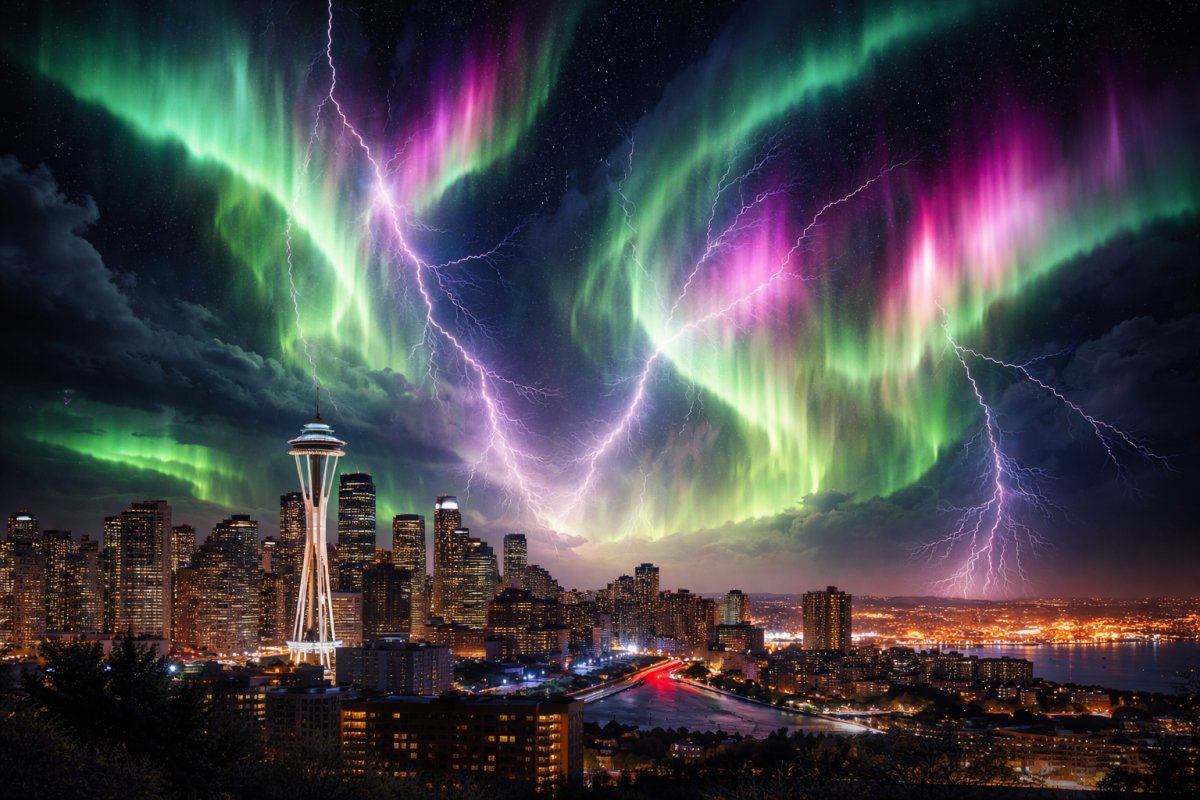
While often associated with polar regions, Seattle's latitude positions it on the cusp of potential aurora borealis visibility during significant geomagnetic events. The city, cradled between Puget Sound and the Cascade Mountains, normally bathes in its own urban glow, making aurora sightings a rare and coveted spectacle. Yet, under conditions of extreme solar activity, a faint, ethereal luminescence can sometimes grace the northern horizon, a fleeting reminder of the universe's grand display.
The quest to witness the northern lights in Seattle is a testament to perseverance, often requiring clear, dark skies away from the city's light pollution, coupled with a robust geomagnetic forecast. It is a pursuit that connects the urban dweller to the vastness of space, momentarily shifting focus from the city's skyline to the heavens.
The city's luminous embrace, while enchanting, often serves as a formidable curtain, obscuring the delicate dance of the northern lights.
Unveiling the invisible forces
Understanding the likelihood and intensity of magnetic storms in Seattle involves tracking several key parameters of space weather. These measurements provide insights into the solar wind's characteristics and its interaction with Earth's magnetosphere, guiding predictions for phenomena like the aurora borealis and potential disruptions.
Key parameters for geoactivity
| Parameter | Description | Relevance to Seattle |
| Kp-index | A global indicator of geomagnetic activity on a scale from 0 to 9 | Higher values (Kp 5 and above) increase the probability of aurora visibility in Seattle |
| Bz component | The north-south component of the interplanetary magnetic field (IMF) | A strong southward (negative) Bz is critical for the effective coupling of solar wind energy into Earth's magnetosphere, enhancing aurora potential |
| Solar wind speed | Velocity of charged particles streaming from the sun toward Earth | Faster solar wind speeds (e.g., above 500 km/s) can lead to more intense and rapid geomagnetic storm development |
| Density | Number of particles per cubic centimeter in the solar wind | Higher solar wind density can amplify the impact on Earth's magnetic field, contributing to stronger storms |
| IMF magnitude | Total strength of the interplanetary magnetic field | A stronger IMF, especially when coupled with a negative Bz, can intensify geomagnetic disturbances |
For Seattleites, monitoring the Kp-index is paramount. A Kp-index of 5 (minor storm) might allow a faint view from very dark locations, while a Kp 7 or higher (strong storm) significantly increases the chances for a visible aurora, even from slightly less optimal vantage points north of the city.
The terrestrial pulse of cosmic events
Beyond the breathtaking potential for northern lights, magnetic storms carry tangible, albeit rare, implications for modern infrastructure. Seattle, a hub of technology and connectivity, is not entirely immune to the subtle ripples these solar events can send through our technological fabric.
Potential impacts on technology
- Power grid stability
Geomagnetically Induced Currents (GICs) can flow through long conductors like power transmission lines, potentially stressing transformers and, in extreme cases, leading to localized power outages. While rare in Seattle, strong storms are monitored by utilities. - Communication disruptions
High-frequency radio communications, vital for aviation and emergency services, can be disrupted or blacked out during intense solar flares and geomagnetic storms. - GPS accuracy
Satellite signals, including those used by GPS systems, can be affected by disturbances in the ionosphere, leading to degraded accuracy for navigation and positioning services. - Satellite operations
Satellites themselves can experience increased drag, radiation exposure, and even temporary malfunctions from charged particle bombardment, impacting services like weather forecasting and internet connectivity.
These impacts, while not a daily concern, underscore the interconnectedness of our terrestrial systems with the dynamic environment of space. Preparedness and monitoring by entities like NOAA's Space Weather Prediction Center are crucial for mitigating potential risks to critical infrastructure in regions like Seattle.
Chasing the aurora in an urban twilight
For those in Seattle yearning to witness the aurora, strategic planning is essential. Seeking locations north of the city, away from streetlights and building glow, significantly enhances visibility. Places like the Olympic Peninsula, Whidbey Island, or even specific viewpoints in North Seattle with an unobstructed northern horizon, become prime spots during a high Kp forecast.
The fleeting nature of these celestial visits makes them all the more precious. A sudden burst of green or red light on the horizon, glimpsed between breaks in the clouds, can transform an ordinary Seattle night into an extraordinary astronomical event, a vivid reminder of the solar wind's relentless journey and its magical touch upon our world.
To catch the aurora in Seattle is to witness a rare convergence of cosmic power and urban serenity, a reminder that the universe still holds secrets visible to the patient eye.
Magnetic storms in Seattle, though often unseen, are a fundamental aspect of Earth's interaction with the sun. They are a force that shapes the potential for ethereal light displays and reminds us of the planet's intricate dance within the solar system, subtly influencing our technological landscape even as they paint the skies.