
A cosmic symphony above the Rose City
Portland, a city often draped in temperate rain and soft, diffused light, occasionally finds itself a stage for a spectacle of cosmic proportions. Beyond the urban hum and the verdant embrace of the Pacific Northwest, invisible forces from the sun continually interact with our planet, sometimes culminating in magnetic storms that can ripple through the very fabric of our local experience. These aren't storms of wind and rain, but rather magnificent electromagnetic tempests, born millions of miles away, yet capable of painting the northern horizon with ethereal light or subtly nudging our technological infrastructure.
Unveiling the solar engine
From solar flares to terrestrial glow
The genesis of a magnetic storm lies within the fiery heart of our sun. Solar flares, immense bursts of radiation, and Coronal Mass Ejections (CMEs), which are colossal expulsions of plasma and magnetic field, propel charged particles across the vast expanse of space. When these energetic particles, traveling as solar wind, collide with Earth's magnetosphere – our planet's protective magnetic bubble – a complex dance of energy transfer begins. The magnetosphere, compressed and buffeted, channels these particles towards the polar regions, where they excite atmospheric gases, causing them to emit light, a phenomenon we know as the aurora. For Portland, far from the Arctic circle, this requires particularly intense solar events.
The very air we breathe becomes a conduit for these extraterrestrial energies, transforming into a canvas for a light show usually reserved for more northern latitudes.
Gauging the geomagnetic pulse
Predicting and understanding magnetic storms requires a suite of sophisticated measurements. Scientists monitor various parameters that indicate the intensity of solar activity and its potential impact on Earth. These metrics help determine the likelihood and strength of an auroral display reaching Portland's skies and the potential for terrestrial effects.
Here are some key parameters used in geoactivity monitoring:
| Parameter | Description | Typical Range/Significance |
|---|---|---|
| Kp-index | Global planetary K-index, a measure of geomagnetic storm strength | 0-9 (0-3 quiet, 4 unsettled, 5+ storm) |
| G-scale | NOAA's G-scale for geomagnetic storms, based on Kp-index | G1 (minor) to G5 (extreme) |
| Bz (IMF) | North-South component of the Interplanetary Magnetic Field | Southward Bz (negative) favors aurora; measured in nT |
| Proton Density | Concentration of protons in the solar wind | Higher density can increase auroral intensity; measured in p/cm³ |
| Solar Wind Speed | Velocity of the solar wind plasma | Faster speeds enhance aurora; measured in km/s |
Portland’s atmospheric canvas
Light pollution's ethereal veil
While the celestial mechanics of magnetic storms are universal, the local conditions in Portland significantly influence the visibility of the aurora. The urban glow of the city, a testament to human activity, presents a formidable challenge. Light pollution from streetlights, buildings, and vehicles can easily outshine the delicate hues of a distant auroral display, masking the subtle greens, reds, and purples that might otherwise grace the horizon. Observers often need to venture away from the city center, seeking darker skies in rural areas or higher elevations, to fully appreciate the potential spectacle.
The elusive dance of light
For an aurora to be visible in Portland, a Kp-index of 6 or higher is generally required, indicating a significant geomagnetic storm. Even then, the display often appears as a faint glow on the northern horizon rather than vibrant, dancing curtains directly overhead, which are characteristic of higher latitudes. Optimal viewing conditions include clear, moonless nights, with a wide, unobstructed view to the north. Patience is a virtue, as the aurora can be intermittent and often more visible to the sensitive lens of a camera than to the naked eye, particularly in a location like Portland.
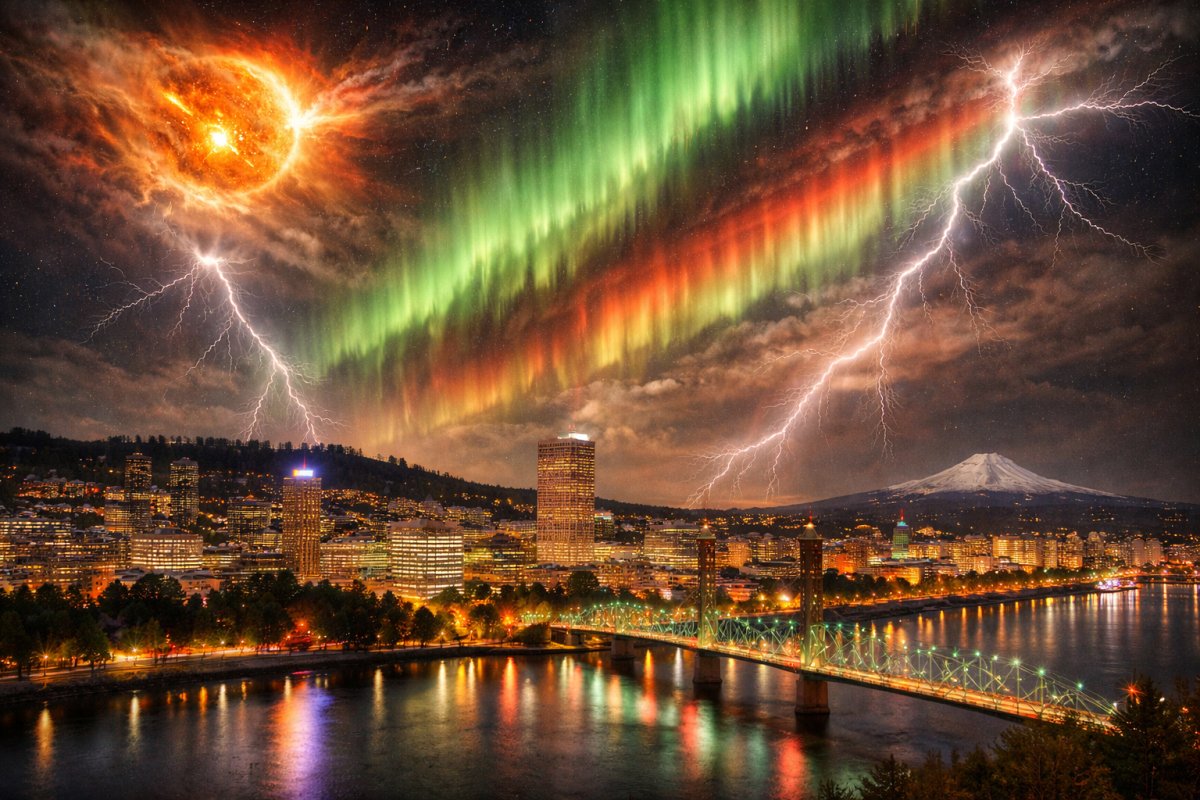
The silent undulations of the magnetosphere are far more than just a light show; they are a profound reminder of our planet's cosmic connections.
Earthly echoes of solar wrath
Infrastructure under celestial stress
Beyond the visual spectacle, powerful magnetic storms can have tangible impacts on modern infrastructure. The induced currents from rapidly changing magnetic fields can flow through long conductors like power transmission lines, potentially causing voltage fluctuations, tripping protective relays, or even damaging transformers. While Portland's grid is designed with certain safeguards, extreme events necessitate vigilance. Similarly, satellite communications, GPS signals, and high-frequency radio transmissions can experience interference or disruption during intense geomagnetic activity, affecting everything from navigation systems to emergency services.
Navigational nuances and natural whispers
Magnetic storms can also cause compass deviations, subtly altering the reliability of magnetic navigation. While most modern systems rely on GPS, which can also be affected, traditional magnetic compasses become less accurate during these events. More esoterically, some studies suggest that certain migratory animals, known to use Earth's magnetic field for navigation, might experience disorientation during intense storms, though definitive links remain a subject of ongoing research. These subtle effects highlight the pervasive reach of solar activity, touching both our technology and the natural world in ways we are still fully understanding.
Witnessing the invisible threads
Capturing the fleeting light
For those in Portland eager to witness and document a magnetic storm's auroral glow, specialized photography techniques are essential. Long-exposure photography, utilizing wide-angle lenses and sturdy tripods, can capture light that is often too faint for the human eye to perceive clearly. Adjusting ISO settings and aperture for low-light conditions allows cameras to collect enough photons to reveal the aurora's intricate patterns and colors. Planning involves monitoring space weather forecasts and heading to locations with minimal light pollution, such as areas along the Oregon Coast or in the Cascade foothills, offering a clearer northern view.
Community and cosmic connection
The shared anticipation of a potential aurora transforms observation into a community experience. Local astronomy clubs, social media groups, and online forums dedicated to space weather often buzz with alerts and real-time updates when a strong magnetic storm is anticipated. These communities provide valuable information on optimal viewing times and locations, fostering a sense of collective wonder. Citizen scientists contribute by sharing their observations and photographs, helping to document the reach and intensity of these cosmic events, turning a rare occurrence into a shared moment of connection with the broader universe, right from the edges of the Rose City.