
Magnetic storms and the desert sky
A celestial paradox
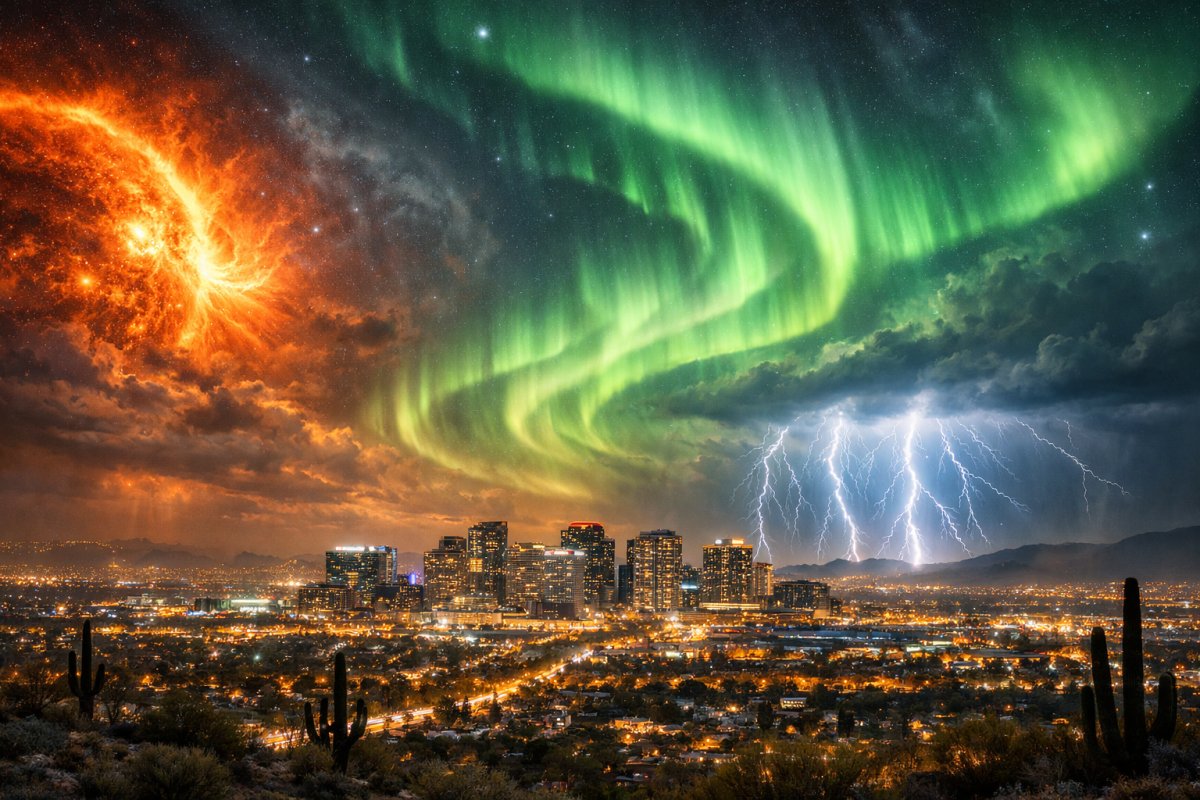
The vast, unblinking azure expanse above Phoenix, typically a canvas of fierce sunshine and star-dusted nights, occasionally thrums with echoes of distant stellar fire. Magnetic storms, born from the tumultuous heart of our sun, cast invisible ripples across the cosmos, eventually meeting Earth's protective magnetosphere. In a city famed for its relentless daylight and the profound silence of its surrounding Sonoran Desert, these events introduce a subtle, yet powerful, cosmic drama. While auroral displays are exceedingly rare at such latitudes, the underlying geomagnetic disturbances are very real, silently influencing everything from power grids to migrating birds, all beneath a sky that often remains deceptively serene.
The sun's fiery breath reaching earth
Decoding solar eruptions
The sun, a benevolent furnace of life, also harbors a volatile temper. Coronal Mass Ejections (CMEs) and solar flares erupt from its superheated surface, unleashing torrents of plasma and high-energy particles into space. When these celestial gales sweep towards Earth, they collide with our planet's magnetic shield. This impact can compress and distort the magnetosphere, generating powerful electric currents that cascade through the upper atmosphere. Far from the polar regions where these interactions paint the sky with vibrant light, the effects in Phoenix manifest as an unseen pressure, a dynamic shift in the electromagnetic environment, a silent whisper of the sun's immense power.
The sun’s tempestuous exhalations, traveling millions of miles, ultimately touch every corner of our planet, even the sun-baked silence of the Sonoran Desert.
Measuring geomagnetic intensity
Key indices of disturbance
To quantify the often-invisible forces of a geomagnetic storm, scientists employ a suite of sophisticated instruments and indices. These measurements provide crucial insights into the solar wind's properties and its interaction with Earth's magnetosphere, allowing for predictions and assessments of potential impacts. Understanding these parameters helps us track the cosmic weather that can subtly, yet significantly, affect ground-based systems even in arid, low-latitude regions like Phoenix.
Key parameters for monitoring geomagnetic activity
| Parameter | Description | Typical values (quiet) | Typical values (storm) |
|---|---|---|---|
| Kp-index | Planetary K-index Global geomagnetic activity over 3-hour intervals | 0-3 | 5-9 |
| G-scale | NOAA Geomagnetic Storm Scale Categorizes storm severity | G0 (minor) | G1-G5 (moderate to extreme) |
| Bz (IMF) | Interplanetary Magnetic Field (IMF) Z-component Orientation of the magnetic field carried by the solar wind | Northward (+Bz) | Southward (-Bz) |
| Solar Wind Speed | Velocity of the solar wind particles impacting Earth | 300-500 km/s | 500-1000+ km/s |
| Solar Wind Density | Concentration of particles in the solar wind | 5-10 particles/cm³ | 20-50+ particles/cm³ |
Invisible currents impacting the valley
Infrastructure at risk
While Phoenix residents might not witness the shimmering curtains of an aurora borealis, the city's complex infrastructure remains susceptible to the unseen currents induced by severe magnetic storms. Geomagnetically Induced Currents (GICs) can flow through long conductors like power transmission lines and pipelines, potentially overloading transformers, causing widespread power outages, or accelerating corrosion. Satellite communications, critical for GPS navigation and local broadcasting, can experience signal degradation or complete blackouts due to disruptions in the ionosphere. The desert's relative isolation offers no immunity to these global phenomena, making preparedness a vital consideration for urban resilience.
Beneath the relentless Arizona sun, unseen surges born from distant solar flares can ripple through the very veins of our modern existence.
Subtle environmental shifts
Beyond technological vulnerabilities, there's growing research into the more nuanced effects of geomagnetic disturbances. Migratory animals, particularly birds that rely on Earth's magnetic field for navigation, might experience disorientation during intense storms. The delicate balance of natural systems, often overlooked, could be subtly swayed by these cosmic incursions. Even subtle shifts in atmospheric chemistry or cloud formation have been posited as potential, albeit less understood, consequences.
Protecting phoenix from cosmic ripples
Local mitigation strategies
Confronting the silent threat of magnetic storms requires a proactive approach. Utilities in the Phoenix metropolitan area, along with national agencies, are increasingly focusing on hardening critical infrastructure. This includes deploying specialized equipment to monitor GICs, installing protective devices on transformers, and developing operational protocols for grid management during high-alert periods. For a city as sprawling and reliant on technology as Phoenix, safeguarding against these cosmic events is not merely a scientific curiosity but an imperative for continued societal function.
The role of early warning
Effective space weather forecasting is paramount. Real-time data from solar observatories and satellites, combined with sophisticated predictive models, allows for crucial lead times. These warnings enable power operators to take precautionary measures, such as reducing voltage or re-routing power, minimizing potential damage. For Phoenix, nestled in a region of critical national infrastructure, these early alerts are the front line of defense against an invisible, yet potent, celestial force.
Future outlook for solar vigilance
Technological advancements
The quest to better understand and predict magnetic storms is an ongoing scientific endeavor. New satellite missions, advanced computational models, and deeper insights into solar physics are continually enhancing our capabilities. For Phoenix, this translates into an evolving landscape of improved resilience, where the sun's dynamic ballet is observed with increasing precision, ensuring that the desert's technological heart can continue to beat steadily, even when celestial currents rage. The desert sky, while largely untouched by the visual spectacle of an aurora, stands as a testament to the pervasive reach of our star, a constant reminder of Earth's place within a vibrant, often turbulent, solar system.