
The cosmic dance above Omaha
In the quiet expanse above Nebraska’s most populous city, unseen forces from the sun periodically orchestrate a grand, silent ballet. While Omaha typically concerns itself with agricultural yields, bustling commerce, and the gentle flow of the Missouri River, a powerful cosmic phenomenon, magnetic storms, silently influences its very infrastructure and environment. These events, born billions of miles away, are a stark reminder of Earth's intricate connection to the solar system, transforming our planet into a dynamic recipient of celestial energy.
The sky above the Great Plains, usually a canvas for serene sunsets and prairie thunderstorms, occasionally holds the potential for a different kind of spectacle. Even without visible aurora displays that characterize higher latitudes, the magnetic field enveloping Omaha vibrates with energies originating from the solar corona, a constant, potent reminder of our shared galactic neighborhood.
Understanding geomagnetic disturbances
Solar eruptions and their journey
Magnetic storms, more formally known as geomagnetic storms, are disturbances in Earth’s magnetosphere caused by enhanced solar wind activity. The sun, a volatile star, regularly ejects plasma and magnetic fields into space through phenomena like solar flares and coronal mass ejections (CMEs). When these energetic bursts are directed towards Earth, they can travel at incredible speeds, reaching our planet in anywhere from a few hours to several days.
Upon impact, the solar wind's magnetic field interacts with Earth's protective magnetosphere. If the interplanetary magnetic field (IMF) has a strong south-pointing component (negative Bz), it can reconnect with Earth's north-pointing magnetic field lines. This magnetic reconnection opens a pathway, allowing solar wind energy and particles to penetrate deep into the magnetosphere, triggering a geomagnetic storm.
"Omaha, nestled in its Midwestern calm, experiences the reverberations of solar energy, an invisible hand from the cosmos altering the very magnetic fabric of our existence."
Measuring the impact
The intensity of geomagnetic activity is often quantified by the Kp-index, a global proxy for geomagnetic storms derived from magnetometer readings. This index ranges from 0 to 9, with higher numbers indicating more severe disturbances. A Kp of 5 or greater signifies a geomagnetic storm, ranging from G1 (minor) to G5 (extreme).
For Omaha, a city situated at a geomagnetic latitude that typically requires higher Kp values for visible auroras, the internal infrastructure still feels the strain of even moderate storms. The Kp-index provides a crucial, real-time assessment for utilities and communication networks in the region.
Omaha's vulnerability and resilience
Infrastructure at risk
While dramatic auroras are a rare treat in Omaha, the more insidious effects of magnetic storms pose genuine challenges. Power grids are particularly vulnerable. Geomagnetic induced currents (GICs) can flow through long conductors like power transmission lines, leading to voltage fluctuations, transformer saturation, and even permanent damage. The intricate network supplying electricity to Omaha's homes and businesses could experience significant stress during a strong geomagnetic event.
The robust design of modern power systems in areas like Nebraska often incorporates measures to mitigate GIC effects, but extreme storms test these safeguards. Monitoring and predictive modeling are essential for maintaining grid stability.
Protecting our digital lifeline
Beyond the power grid, other vital systems are susceptible. Satellite-based communication and navigation, crucial for everything from GPS in cars navigating Omaha streets to agricultural machinery working Nebraska fields, can be disrupted. Magnetic storms can cause errors in GPS positioning and interfere with radio communications, including those used by airlines and emergency services.
"The digital pulse of Omaha, a city ever-connected, beats in rhythm with a subtle, yet powerful, cosmic drum, demanding vigilance against unseen disruptions."
High-frequency radio signals, which rely on the ionosphere for reflection, can be absorbed or scattered during storms, leading to radio blackouts. This affects amateur radio operators, long-distance communication, and even some military operations based near Omaha.
The science behind the spectacle
Parameters of geoactivity
Understanding and predicting the impact of magnetic storms relies on monitoring several key parameters related to space weather. These measurements provide insights into the strength, direction, and speed of the solar wind interacting with Earth.
| Parameter | Description | Typical Impact |
|---|---|---|
| Kp-index | Planetary K-index, a 3-hour global average of geomagnetic activity | Overall storm severity, aurora visibility, GIC potential |
| Bz (IMF Z component) | North-south component of the Interplanetary Magnetic Field | Critical for magnetic reconnection; negative Bz indicates high storm potential |
| Solar Wind Speed | Velocity of solar plasma flowing from the sun | Faster speeds mean stronger impact on magnetosphere |
| Proton Density | Number of protons per cubic centimeter in the solar wind | Higher density can amplify geomagnetic effects |
| Dst-index | Disturbance Storm Time index, measures worldwide average horizontal component of Earth's magnetic field | Indicates the intensity of the storm's main phase and ring current strength |
Unseen beauty
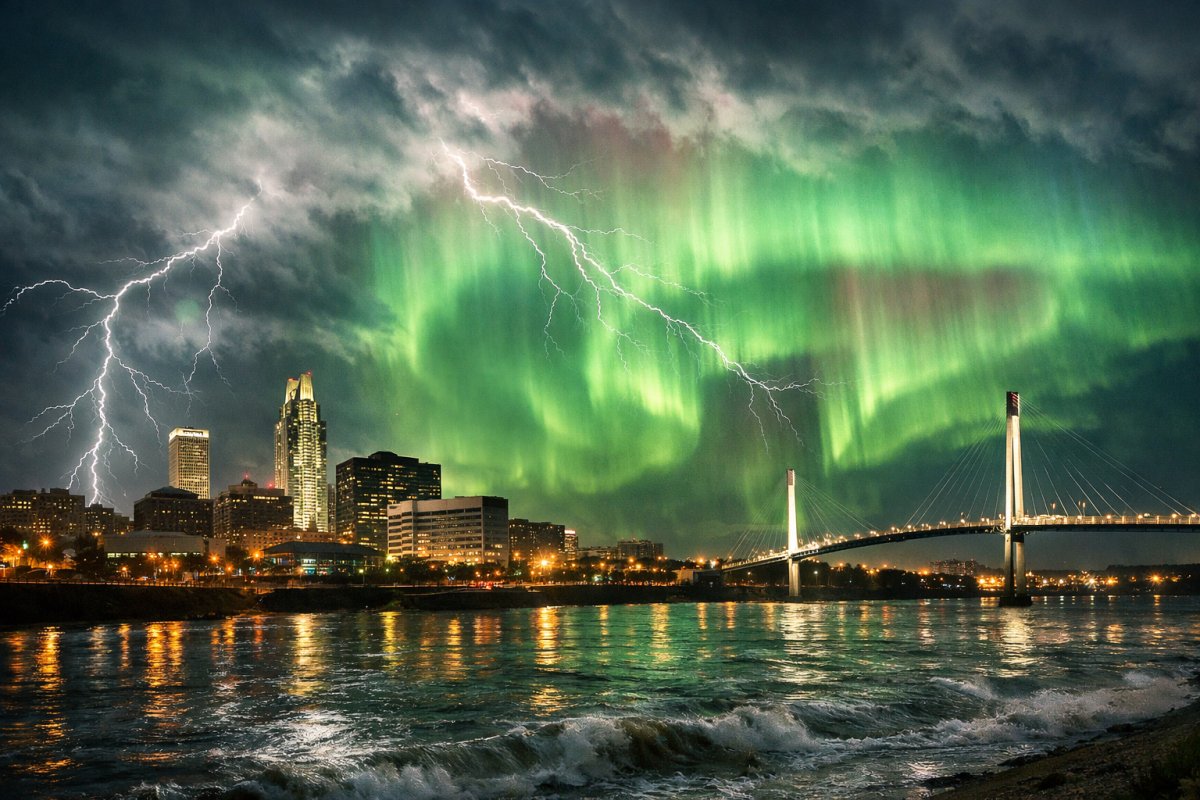
While rare, exceptionally powerful geomagnetic storms can push the aurora borealis, or northern lights, to lower latitudes, offering a breathtaking display even in places like Omaha. The dancing lights are caused by energetic particles from the solar wind colliding with atoms and molecules in Earth's upper atmosphere, exciting them and causing them to emit light.
For residents of Omaha, a sighting of the aurora is a profound, unforgettable experience, a direct visual link to the powerful cosmic forces usually felt only through their subtle effects on technology. It’s a moment when the invisible hand of the sun becomes vibrantly, spectacularly visible.
Practical implications for the heartland
Protecting against the invisible current
For utility companies serving Omaha and the surrounding plains, continuous monitoring of space weather is paramount. Operators can take proactive measures during impending storms, such as reconfiguring power grids, reducing loads, or temporarily taking susceptible equipment offline. These strategies are vital for preventing widespread blackouts and ensuring the reliability of essential services.
Researchers continue to develop advanced models to predict GICs more accurately, tailored to the specific geology and grid characteristics of regions like Nebraska. This localized understanding is key to building more resilient infrastructure.
Personal preparedness and awareness
While major disruptions are infrequent, an awareness of space weather provides a unique perspective for individuals in Omaha. It underscores the fragility of our technological reliance and encourages a deeper appreciation for the planet’s natural defenses.
"The subtle hum of everyday life in Omaha masks a grander cosmic symphony, where solar winds and magnetic fields play a part, reminding us of our delicate yet resilient place in the universe."
For the average citizen, understanding the potential impact can mean being prepared for localized power outages or temporary communication difficulties, just as one would for severe terrestrial weather. It’s a reminder that even in the heart of America, our lives are intricately connected to the vast, dynamic forces of the cosmos.
Monitoring the invisible forces
Agencies like NOAA's Space Weather Prediction Center (SWPC) provide critical forecasts and real-time data on geomagnetic activity, offering a window into these powerful solar phenomena. For Omaha, this continuous flow of information is an indispensable resource, allowing for preparedness and adaptation in the face of cosmic variability.
From the subtle hum in a power line to the potential for ethereal lights gracing the night sky, magnetic storms are an enduring presence in Omaha's interaction with the solar system. They challenge our infrastructure, ignite our curiosity, and remind us of the profound, invisible ties that bind our terrestrial existence to the fiery heart of our star.