
The invisible currents over the Sooner State
While Oklahoma City often casts its gaze skyward for the dramatic spectacle of severe weather, an equally potent, yet largely unseen, atmospheric phenomenon frequently dances above its sprawling landscape: magnetic storms. These celestial disturbances, far from the terrestrial winds and frontal systems, originate billions of miles away at the sun’s turbulent surface, delivering energetic particles that interact profoundly with Earth's protective electromagnetic shield. For OKC, a vibrant hub of technology, agriculture, and aviation, understanding these invisible currents is not merely an academic exercise but a practical consideration for critical infrastructure and daily operations.
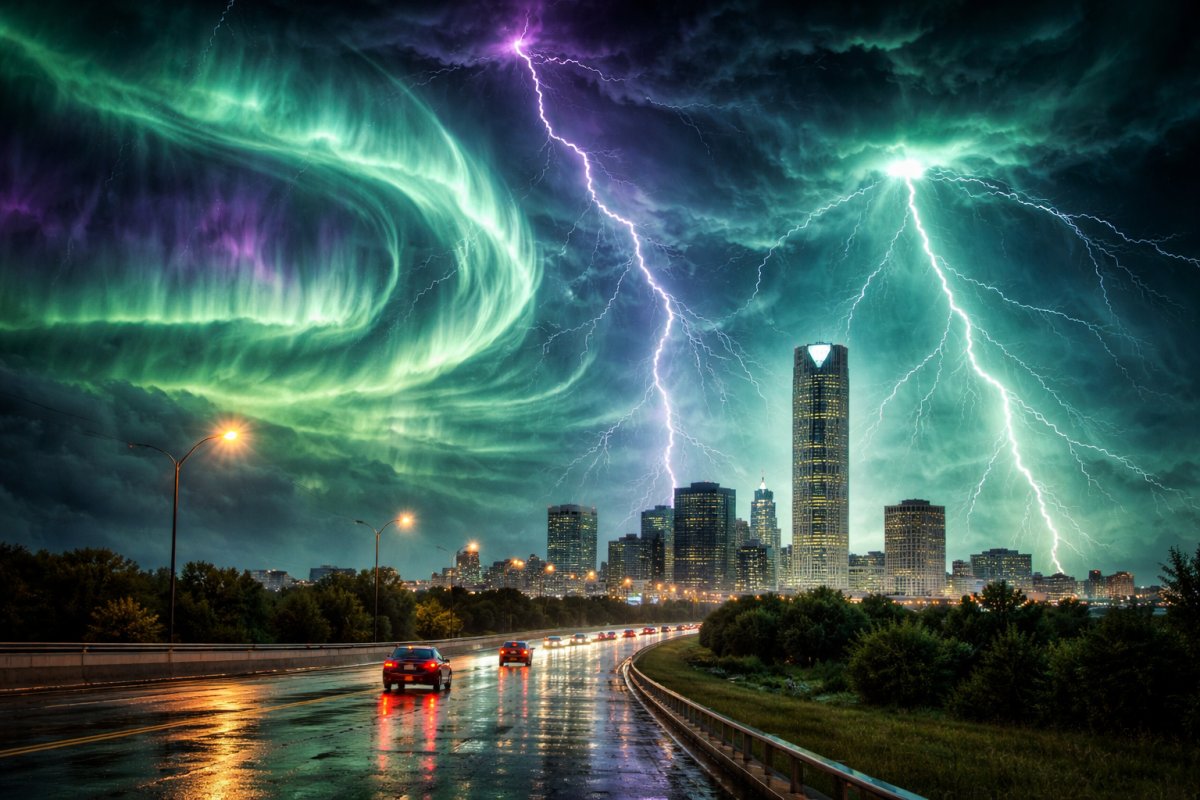
Beyond the thunderous skies, a silent solar tempest often reconfigures the very electromagnetic fabric of our Oklahoma world.
These geomagnetic events are not a localized weather pattern but a global phenomenon, with distinct regional impacts. While the dramatic aurora borealis, the iconic visible manifestation of these storms, rarely graces Oklahoma's southern latitudes with vibrant intensity, the underlying electromagnetic disruptions still ripple through the region. From the subtle perturbations in satellite navigation to the less obvious stresses on power grids, the magnetic whispers from the sun demand a nuanced appreciation of their power and influence.
Understanding geomagnetic turbulence
What drives the disturbance
The genesis of a magnetic storm lies in the volatile heart of our star. The sun periodically erupts with immense bursts of energy, manifesting as solar flares-intense flashes of radiation-or more significantly, Coronal Mass Ejections (CMEs). CMEs launch billions of tons of solar plasma and embedded magnetic fields into space at speeds ranging from a few hundred to over two thousand kilometers per second. When these colossal clouds of magnetized particles are directed towards Earth, they present a formidable challenge to our planet's intrinsic defenses.
The solar wind, a constant stream of charged particles emanating from the sun, acts as the primary medium, carrying these powerful disturbances across the vast expanse of interplanetary space. It is the arrival of these high-speed streams or CME shockwaves at Earth's vicinity that initiates the complex cascade of events culminating in a geomagnetic storm.
Earth's protective embrace
Our planet possesses a remarkable, albeit invisible, shield: the magnetosphere. This vast magnetic bubble, generated by Earth's molten iron core, deflects most of the incoming solar wind and its energetic passengers. However, during a powerful solar event, the incoming magnetic fields from the sun can temporarily merge with Earth's own field, creating breaches in this protective barrier. This allows a surge of highly energized particles to penetrate deeper into our atmosphere, particularly around the polar regions where magnetic field lines converge.
As these charged particles cascade into the upper atmosphere, primarily the ionosphere, they excite atoms and molecules, causing them to glow (the aurora), but also inducing electric currents and altering the density and composition of this crucial atmospheric layer. These changes in the ionosphere are the immediate cause of many of the observable technological impacts experienced at Earth's surface, including over Oklahoma City.
Oklahoma City's unique electromagnetic canvas
Oklahoma City, situated in a mid-latitude region, experiences geomagnetic storms differently than locations closer to the magnetic poles. While intense auroral displays are rare, the electromagnetic landscape here is still subject to significant shifts during periods of elevated solar activity. The impact is often less about visual spectacle and more about the imperceptible but critical disruptions to modern conveniences and vital infrastructure.
Radio and communication ripples
The ionosphere, a critical layer for radio wave propagation, becomes turbulent and unpredictable during magnetic storms. For Oklahoma City, this can translate into more than just static on a radio. Industries reliant on precise and consistent communication channels can face challenges.
- Interference in high-frequency (HF) radio communication, affecting aviation and military operations
- Degradation of Global Positioning System (GPS) signal precision, impacting precision agriculture, surveying, and logistics
- Potential disruption to satellite communication links, critical for remote data transfer
- Challenges for amateur radio operators in maintaining long-distance contacts
Grid vulnerabilities and resilient infrastructure
The vast network of power lines spanning Oklahoma's landscape acts like an enormous antenna, susceptible to geomagnetically induced currents (GICs). These unwanted currents can flow into the electrical grid, placing unforeseen stress on critical components like transformers. For Oklahoma City, with its growing energy demands and interconnected grid, understanding and mitigating this risk is paramount.
- Voltage fluctuations in high-voltage transmission lines
- Increased magnetic saturation and heating in power transformers, potentially leading to premature aging or failure
- Localized power disturbances or brownouts, though widespread blackouts are rare for mid-latitude regions
- Need for advanced monitoring and protective measures in grid design and operation
Gauging the storm's intensity
The Kp-index unravelled
To quantify the global level of geomagnetic activity, scientists use the Kp-index, a planetary index derived from a network of ground-based magnetometers. Ranging from 0 (very quiet) to 9 (extreme storm), this index provides a valuable measure for assessing potential impacts on technology and infrastructure, even in places like Oklahoma City where the visible effects are minimal. A higher Kp value indicates stronger disturbance of Earth's magnetic field.
| Kp-index | Geomagnetic Activity Level | Potential Impacts |
|---|---|---|
| 0-1 | Quiet | Minimal to no observable effects on systems |
| 2-3 | Unsettled | Minor GPS inaccuracies, subtle ionospheric changes |
| 4 | Active | Moderate HF radio fading, increased satellite drag |
| 5 (G1) | Minor Storm | Increased satellite drag, occasional power grid fluctuations |
| 6 (G2) | Moderate Storm | Widespread HF radio absorption, possible power system alarms |
| 7 (G3) | Strong Storm | Intermittent satellite navigation issues, some power system damage |
| 8 (G4) | Severe Storm | Extensive power outages possible, major GPS disruptions |
| 9 (G5) | Extreme Storm | Catastrophic power grid failure, global communication loss |
Observing the solar whispers
Forecasting geomagnetic storms relies on a global network of sophisticated instruments. Satellites positioned between the sun and Earth, such as the DSCOVR satellite, provide crucial early warnings, measuring the solar wind's speed, density, and magnetic field orientation as it approaches our planet. Ground-based magnetometers continuously monitor local magnetic field variations, providing real-time data on the storm's intensity and evolution.
Organizations like the NOAA Space Weather Prediction Center (SWPC) analyze this vast stream of data to issue alerts and warnings, allowing critical infrastructure operators in Oklahoma City and beyond to prepare for potential impacts. These alerts, often indicating projected Kp levels, enable proactive measures to safeguard vulnerable systems.
Adapting to celestial forces
While the prospect of magnetic storms might evoke images of sci-fi disruptions, for Oklahoma City, adaptation is a matter of practical resilience rather than apocalyptic preparation. Industries heavily reliant on precise positioning, robust communication, and stable power require a nuanced understanding and proactive approach to space weather. The key lies in monitoring, planning, and building robustness into systems.
While we cannot command the sun, we can certainly chart its influence and fortify our vital systems against its distant, powerful breath.
From modernizing power grid components to developing alternative communication strategies, the response to magnetic storms in Oklahoma City is characterized by thoughtful engineering and informed decision-making. By embracing the reality of space weather, the region can continue its trajectory of growth and innovation, secure in its capacity to navigate even the most distant of environmental challenges.
- Regular monitoring of space weather forecasts and alerts by critical infrastructure operators
- Implementation of resilient grid technologies, such as GIC blocking devices for transformers
- Developing contingency plans for satellite communication and GPS disruptions in aviation and logistics
- Educating key personnel across industries on the potential impacts and mitigation strategies for geomagnetic phenomena
- Investing in advanced forecasting models to improve regional impact assessments