
In the grand cosmic ballet, Earth spins, shielded by an invisible magnetic cocoon. This geomagnetic field, a guardian against the sun's fiery exhalations, occasionally trembles under the weight of solar eruptions, sending ripples through our planet's defenses. Even in the heartland, far from polar expanses, cities like Louisville, Kentucky, subtly register these deep-space tremors, an unseen drama unfolding above its famous riverfront.
Understanding geomagnetic storms
A geomagnetic storm is not a tempest of wind or rain but a disturbance in Earth's magnetosphere, caused by an efficient exchange of energy from the solar wind into the space environment surrounding Earth. This energetic infusion can disrupt our technological systems in ways often overlooked until they occur. The sun, a distant furnace, dictates these events, its volatile surface occasionally flaring with immense power.
Solar wind's invisible embrace
Our planet is constantly bathed in the solar wind, a stream of charged particles ejected from the sun's corona. Most of the time, Earth's magnetic field deflects this plasma. However, when the solar wind intensifies, particularly during coronal mass ejections (CMEs), it can overcome our planet's magnetic shield. These CMEs are colossal bursts of plasma and magnetic field from the sun's corona, hurtling through space at immense speeds. Upon impact, they compress the magnetosphere, injecting energy that can initiate a geomagnetic storm.
Geomagnetic indices and their meaning
To quantify the intensity of these unseen forces, scientists use various indices. These metrics provide a snapshot of the geomagnetic environment, allowing for predictions and assessments of potential impacts. For residents of Louisville, understanding these indices offers a glimpse into the silent forces at play above the Ohio River.
| Parameter | Description | Typical Measurement |
|---|---|---|
| Kp-index | Planetary K-index, a global average of magnetic activity | 0-9 (0 being quiet, 9 being extreme) |
| G-scale | NOAA's Geomagnetic Storm Scale, impact-oriented categorization | G1 (minor) to G5 (extreme) |
| Bz (IMF) | North-south component of the Interplanetary Magnetic Field | Nanoteslas (nT), southward (negative) Bz is critical for storms |
| Solar wind speed | Velocity of the solar wind particles | Kilometers per second (km/s) |
| Proton density | Concentration of protons in the solar wind | Particles per cubic centimeter (p/cm³) |
The science of geomagnetic disturbances
The dance between the sun's fury and Earth's defense is a complex interplay of plasma physics and electromagnetism. Understanding its mechanics is key to appreciating the potential vulnerabilities it introduces, even in urban settings like Louisville.
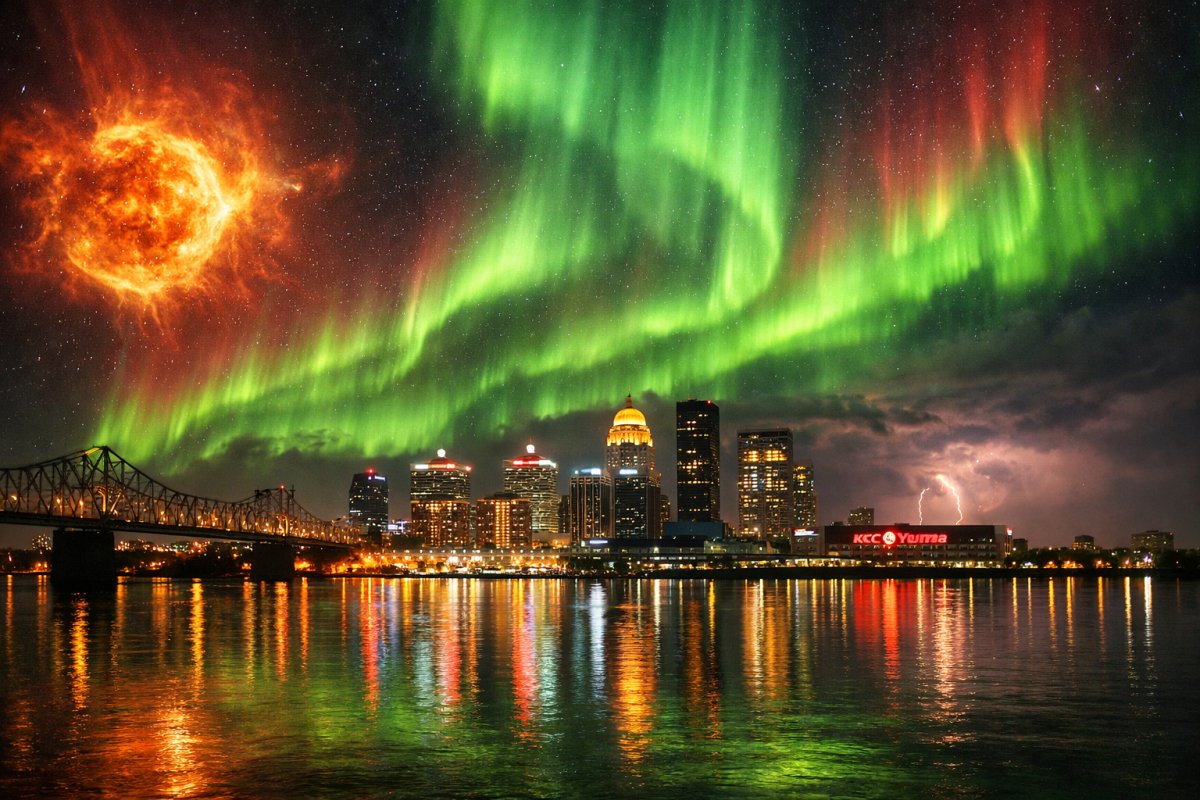
Solar flares and coronal mass ejections
Solar flares are intense bursts of radiation emanating from the sun's surface, traveling at the speed of light. While they primarily affect radio communications and GPS signals almost instantly, it is the slower, more massive CMEs that pose the greater threat for geomagnetic storms. These immense bubbles of plasma can take days to reach Earth, carrying with them embedded magnetic fields. If this magnetic field aligns oppositely to Earth's, it can "reconnect," opening up our planet's magnetic shield to the onslaught of solar particles.
The Earth's magnetosphere, a dynamic shield, constantly shifts and pulses, an invisible guardian against the cosmos.
Earth's magnetic shield
Our planet's magnetic field acts as a formidable barrier, deflecting most of the solar wind. This field originates from the molten iron core of Earth, generating currents that extend far into space, forming the magnetosphere. During a geomagnetic storm, this shield is not broken but rather warped and compressed. The influx of energy causes currents to flow into the ionosphere, particularly at high latitudes, leading to the spectacular aurora and also inducing currents in ground-based conductors.
How Louisville experiences the unseen
While Louisville is far from the Arctic Circle where auroras often paint the night sky, the city is not immune to the subtle, yet potent, effects of geomagnetic storms. The underlying geology and the expanse of its infrastructure become silent receptors for these cosmic energies.
The subtle shifts in local magnetic fields
Even in temperate latitudes, powerful geomagnetic storms can induce ground currents in long conductors, like power lines and pipelines. These Geomagnetically Induced Currents (GICs) flow in response to rapid changes in Earth's magnetic field. For Louisville, with its extensive power grid, water pipelines, and communication cables crisscrossing the landscape and beneath the Ohio River, these induced currents represent an invisible stress on infrastructure designed for more predictable electrical flows. These shifts are imperceptible to human senses but measurable by sensitive instruments.
Potential for skyward spectacle
While rare, exceptionally strong geomagnetic storms have the potential to push the aurora borealis far southward. In such extraordinary circumstances, residents of Louisville might witness a faint, diffuse glow on the northern horizon, a fleeting whisper of the polar lights. It's a reminder that even in urban settings, the cosmos retains its capacity for wonder, occasionally reaching out to touch places unexpected.
Infrastructure vulnerabilities in the river city
Modern society's reliance on technology means that geomagnetic storms, once considered mere celestial curiosities, now pose tangible threats to critical infrastructure, even in a city like Louisville. The interwoven networks that power and connect daily life are the most susceptible.
Power grid resilience
The Louisville metropolitan area relies on an extensive power grid, a web of transformers and transmission lines that keep homes and businesses lit. GICs, while seemingly small, can saturate transformer cores, causing them to overheat and potentially fail. A widespread blackout, triggered by a severe geomagnetic storm, could halt commerce, disrupt transportation, and affect essential services across the city, from the Highlands to the West End. Utility companies continuously monitor space weather reports and invest in mitigation strategies to protect their vital assets.
The hum of electricity, a constant in city life, is an unseen tether to the sun's distant whims.
Communication networks at risk
Beyond power, communication systems are equally vulnerable. High-frequency radio communication, essential for aviation and emergency services, can be severely degraded or blacked out during strong geomagnetic disturbances due to ionospheric disruptions. GPS signals, critical for navigation, logistics, and even timing in financial transactions, can experience accuracy degradation or complete outages. For a bustling hub like Louisville, where goods move by road and river, and precise timing is paramount for industries, such disruptions could ripple through the local economy.
Protecting our digital currents
As our dependence on interconnected technologies deepens, so too does the imperative to fortify our systems against the unpredictable forces of space weather. Louisville, like any modern city, must consider preparedness as part of its resilient urban planning.
Mitigation strategies for utilities
Local and regional utility providers employ a suite of strategies to safeguard their infrastructure. These include installing monitoring equipment to detect GICs, implementing operational procedures to reduce grid load during severe events, and investing in hardened transformer designs. Continuous training and collaboration with space weather forecasting centers like NOAA's Space Weather Prediction Center (SWPC) are vital in preemptive action. Predictive models allow for a window of opportunity, usually several hours, to prepare for a CME's arrival.
Individual preparedness in the digital age
For the individual resident of Louisville, preparedness for a severe geomagnetic storm mirrors general emergency readiness. This includes having alternative communication methods (like battery-powered radios), maintaining an emergency kit with non-perishable food and water, and understanding that GPS might be unreliable. While direct physical harm from magnetic storms is negligible, the potential for prolonged power outages or communication blackouts necessitates a thoughtful approach to personal and family readiness.
Daily life and the magnetic pulse
The pervasive influence of geomagnetic storms, though often invisible, can touch various aspects of daily existence in unexpected ways, extending beyond critical infrastructure to more subtle phenomena.
GPS accuracy and navigation
In Louisville, from delivery drivers navigating urban streets to barges moving along the Ohio River, precision GPS is a cornerstone of modern logistics. Geomagnetic storms can introduce errors into GPS signals as they pass through a disturbed ionosphere. This can lead to inaccuracies in positioning and timing, potentially impacting services that rely on sub-meter precision. While usually temporary, severe disturbances could necessitate reliance on traditional navigation methods or create delays in time-sensitive operations.
Potential biological sensitivities
Scientific research continues to explore the potential, albeit controversial, links between geomagnetic activity and human or animal health. Some studies suggest correlations with subtle changes in mood, sleep patterns, or even biological rhythms in certain sensitive individuals. While no definitive causal link has been universally established, the possibility that our bodies, finely tuned to Earth's natural magnetic field, might register extreme perturbations remains a topic of intriguing inquiry, adding another layer to the unseen pulse of the cosmos within our lived environment.