
Beneath the perpetual glimmer of Hollywood lights and the endless hum of freeway traffic, Los Angeles pulses with an energy uniquely its own. Yet, beyond the visible spectacle of this sprawling metropolis lies a subtle vulnerability, an unseen dynamic influenced by forces far beyond the urban horizon. These are the whispers of the sun, translating into geomagnetic disturbances that can ripple through the very fabric of our tech-dependent world.
The sun's invisible embrace
Far beyond the azure California sky, the sun, our nurturing star, occasionally unleashes torrents of energy. Coronal Mass Ejections (CMEs) and high-speed solar wind streams are the primary architects of what we perceive as magnetic storms. When these eruptions of charged particles collide with Earth's magnetosphere, our planet's natural magnetic shield shivers, sometimes violently. This interaction generates geomagnetic currents that surge through the ionosphere, a critical layer of our atmosphere.
A dance of particles and fields
The journey of these solar particles is an odyssey spanning millions of miles, culminating in an intricate dance with Earth's protective magnetic field. Instead of being a solid barrier, our magnetosphere is a dynamic entity, constantly adjusting and flexing under the solar onslaught. This energetic exchange creates temporary but significant alterations in our planet's magnetic environment.
The quiet hum of the universe carries a latent power, capable of echoing disruptions across terrestrial grids and digital pathways.
Los Angeles at the cosmic crossroads
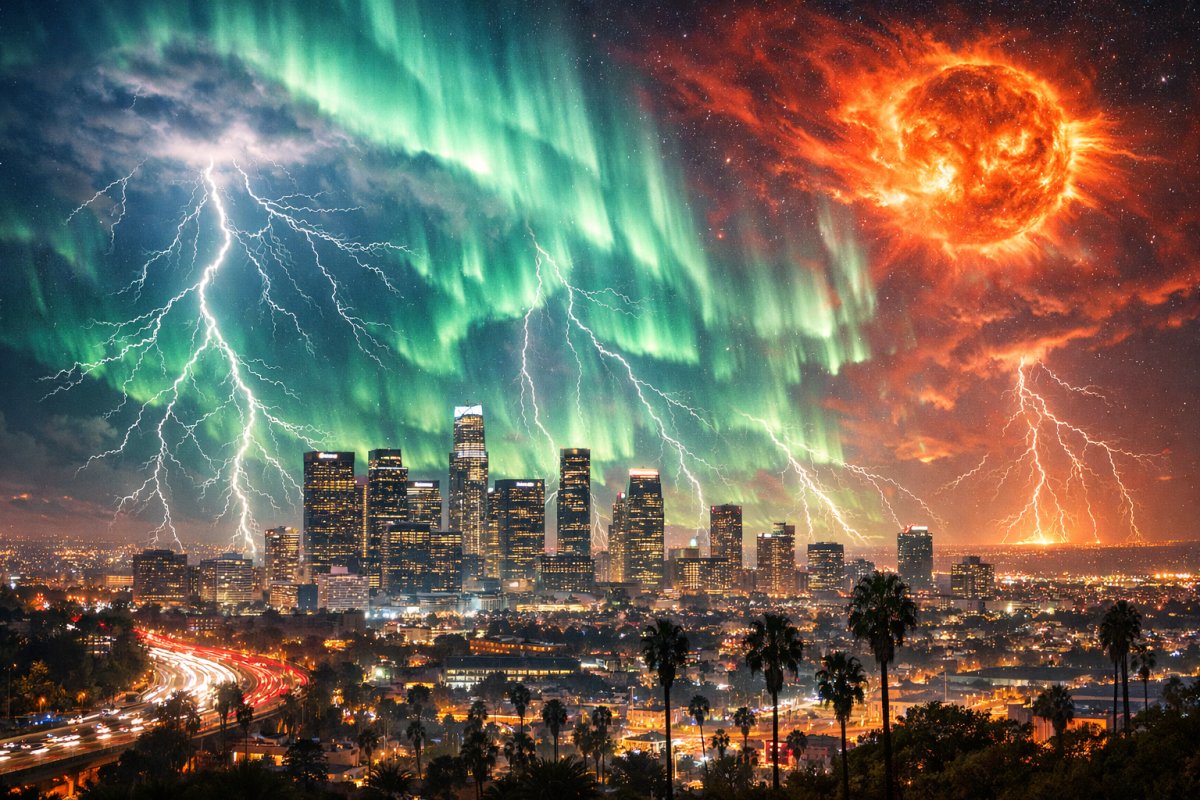
For a city like Los Angeles, a global nexus of technology, entertainment, and logistics, geomagnetic disturbances pose a unique set of challenges. Its dense population, sprawling infrastructure, and reliance on precision technologies make it particularly sensitive to the subtle shifts of space weather.
Power grid perturbations
The vast network of power lines crisscrossing Southern California, designed to deliver electricity to millions, acts like giant antennas. When geomagnetic currents are induced in the Earth's crust, they can create geomagnetically induced currents (GICs) in these long conductors. This can stress transformers, potentially leading to overheating, operational failures, and widespread blackouts. Imagine the darkened skylines, the quieted boulevards, if the grid faltered under an unseen cosmic hand.
Navigational disorientation
GPS is not merely a convenience for Los Angeles residents navigating the intricate freeway system; it's a backbone for aviation, maritime operations, and emergency services. Magnetic storms can disrupt the ionosphere, causing signal scintillation and errors in GPS readings. This means reduced accuracy, or even temporary loss of signal, affecting everything from precision landings at LAX to ride-sharing services and package deliveries across the city.
In a city that thrives on immediate connectivity, the unseen hand of solar energy can introduce a jarring latency, a momentary loss of digital certainty.
Communication echoes
Beyond GPS, magnetic storms can interfere with various forms of radio communication. High-frequency (HF) radio, used by aviation, military, and amateur radio enthusiasts, is particularly susceptible to ionospheric disturbances. Satellite communications, vital for broadcasting, internet services, and global connectivity, can also experience disruptions as signals are scattered or absorbed by the turbulent ionosphere. For a city that broadcasts its culture to the world, such interference could be a significant setback.
Gauging earth's tremor
To understand and predict the impact of magnetic storms, scientists monitor several key parameters of geomagnetic activity. These metrics provide a snapshot of the ongoing interaction between the sun and Earth.
| Parameter | Description | Impact significance |
| Kp-index | A planetary index measuring global geomagnetic activity on a scale of 0 (quiet) to 9 (extreme storm) | Primary indicator for overall storm severity and potential for widespread effects |
| Bz (IMF Bz) | The north-south component of the interplanetary magnetic field in nanotesla (nT) | Critical for determining if solar wind will connect with Earth's magnetosphere; negative Bz enhances storm activity |
| Solar Wind Speed | The speed of charged particles flowing from the sun in kilometers per second (km/s) | Higher speeds lead to stronger impacts on Earth's magnetosphere |
| Solar Wind Density | The number of particles per cubic centimeter (particles/cm³) in the solar wind | Higher density often correlates with increased pressure on the magnetosphere |
| Dst-index | Disturbance Storm Time index measuring the intensity of the ring current around Earth in nanotesla (nT) | Measures the strength of global magnetic storms, with larger negative values indicating stronger storms |
Mitigating the cosmic ripple
While we cannot prevent the sun's powerful emanations, advanced space weather forecasting and mitigation strategies are crucial for a city like Los Angeles. Utilities are implementing measures to harden their grids against GICs, such as installing specialized ground-current blocking devices and refining operational procedures. Aviation and shipping industries utilize real-time space weather data to adjust flight paths and navigation protocols.
Preparing for the unforeseen
The collective effort involves scientists constantly observing the sun, engineers fortifying infrastructure, and policymakers developing resilience plans. Education and public awareness also play a vital role, ensuring that preparedness extends beyond specialized industries to the broader community. Los Angeles, in its innovative spirit, is uniquely positioned to lead in adapting to these subtle yet potent cosmic influences.
The resilience of a modern city is not merely in its concrete and code, but in its foresight against the unseen forces that define our place in the cosmos.
The dynamic interplay between our vibrant planet and its star serves as a constant reminder of our cosmic interconnectedness. In Los Angeles, where innovation and natural beauty converge, understanding these magnetic storms adds another fascinating layer to the city's complex narrative, urging us to look upwards, even as we build outwards.